Riddle rounds
Put a set of riddles on the projector. Read the clue, show the hint after 20 seconds, and let the class call out guesses before you reveal the answer. Five riddles fill about five minutes.
Riddles for kids →No-prep · projector-ready · K–5
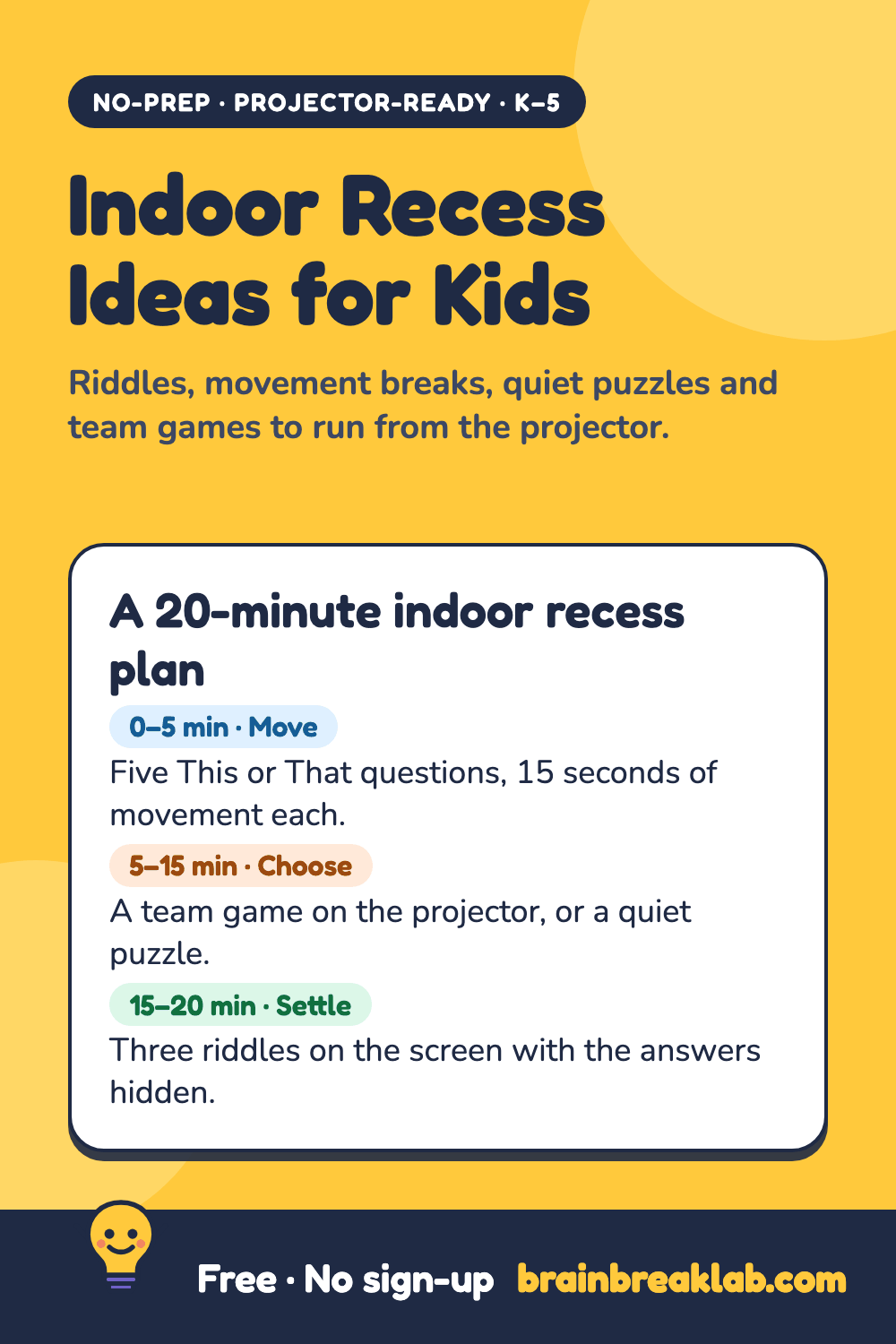
Rain, snow or a heat warning, and twenty minutes to fill without leaving the room. These indoor recess ideas use what you already have: a projector, a timer and the riddles, movement breaks and games on this site. Pick one activity, or run the whole plan below.
Only ten minutes? Do the first and last step. Only a projector and no student devices? Every idea marked for the board works with one student at the keyboard.
Everyone looks at the same screen, and a student can run it.
Put a set of riddles on the projector. Read the clue, show the hint after 20 seconds, and let the class call out guesses before you reveal the answer. Five riddles fill about five minutes.
Riddles for kids →Turn on team scoring in the presenter, split the room into two to four teams, and give a point to the first team with the right answer. Rotate which team guesses first.
Open the riddle presenter →Show today's riddle in the first minute of indoor recess and keep the answer hidden. Students who think they know whisper it to you; everyone finds out at the end.
Today's riddle →Pick a what-am-I riddle for your grade. Instead of shouting guesses, students draw what they think the answer is. Hold up the drawings, then reveal.
Grade-level riddles →No running. Three of these work right next to a desk; four corners needs clear aisles.
Show one question. Each side has its own move, and students pick a side by doing that move for 15 seconds. Ten questions is five minutes of moving in place.
This or That questions →The same idea with sillier choices: ride a dragon or ride a dinosaur? After the move, ask two students to finish “I picked ___ because ___.”
Would You Rather questions →Needs clear aisles to each side of the room. Send each This or That choice to a different side. Students walk, never run, to their side, then look around to see who agrees. Good for a class that needs to move more than stand in place.
Play a song and let kids dance in place. When the music stops, everyone freezes in a stretch until it starts again. Three songs and the wiggles are gone.
For the day the room is already loud, or the class next door is testing.
A tile-matching puzzle for the projector. Students raise a hand when they spot a pair, and the first spotter picks the two tiles. No calling out, just looking.
Mahjong Connect →Seven pieces, one outline to fill. On a student device, one partner moves the pieces while the other gives directions. Shape names sneak in without a lesson.
Tangram →Classic concentration with animal cards, from 6 pairs for kindergarten to 12 for older kids. K–2 can play alone on a tablet; grades 3–5 try to beat their own move count.
Memory Match →Give pairs a word with two meanings (bat, bark, ring, trunk) and a few example riddles. They write one for the class to solve tomorrow.
Older grades: 4th grade riddles · 5th grade logic riddles
Example riddles →Two teams, one board, and a little friendly noise.
Split the room in half. Each team gets ten seconds to agree on a move before one student taps it. The board is built for the projector and keeps score for you.
Tic Tac Toe →One board, one class. Students vote on every slide with hand signals: up, down, left or right. Before two tiles join, ask what number they will make.
2048 →Grades 3–5. Every player gets one run, and the class keeps the best score on the whiteboard. A run takes under a minute, so a whole table group can play in five.
Drift Boss →Needs a strip of open floor for each team, such as the front of the room. Teams line up by birthday month, or by first-name alphabet, without talking. Only hand signals allowed. The first team in the correct order wins.
Looking for something shorter than recess? Our brain break ideas are sorted into 1, 3 and 5-minute activities, and the full list of classroom games has a teacher card for each one.